Course Information
Please Log In for full access to the web site.
Note that this link will take you to an external site (https://shimmer.mit.edu) to authenticate, and then you will be redirected back to this page.
Table of Contents
1) Subject Description
Fundamentals of signal processing, focusing on the use of Fourier methods to analyze and process signals such as sounds and images. Topics include Fourier series, Fourier transforms, the Discrete Fourier Transform, sampling, convolution, deconvolution, filtering, noise reduction, and compression. Applications draw broadly from areas of contemporary interest with emphasis on both analysis and design.
Prerequisite: The prerequisite for 6.300 (formerly 6.003) is 6.100A (formerly 6.0001). Students may also benefit from prior exposure to complex numbers and complex exponential functions.
2) Schedule
Lectures: Tuesdays and Thursdays, 2pm to 3pm, 4-370
Lectures are intended to provide a concise overview of the
technical content as well as the conceptual framework for that content.
Lecture notes are intended to serve as our primary technical reference.
Supplemental references:
- Langton and Levin: The Intuitive Guide to Fourier Analysis & Spectral Estimation
- Oppenheim and Willsky: Signals and Systems
- Oppenheim and Schafer: Discrete-Time Signal Processing
- Jae Lim: Two-Dimensional Signal and Image Processing</li>
Recitations: Tuesdays and Thursdays, 3pm to 4pm, 4-370 or 4-237
Recitations are intended to reinforce material from lecture and to demonstrate how to solve problems using that material.
Office Hours: TBD
Office hours are provided for students to work on homework and lab assignments. Staff members will be available for check-ins and to answer questions about homework, lectures, recitations, or general 6.300-related concepts. Students are encouraged to work together and help each other, subject to the 6.300 collaboration policies. (See below.)
3) Homework
Homework assignments provide opportunities for students to practice using the subject matter so as to better understand the material and how to use it to solve problems.
Weekly homework assignments consist of exercises, problems, and labs. These assigments are posted on the 6.300 website and the links become active at 4pm on Thursdays.
Exercises are intended to reinforce basic concepts introduced in lecture and recitation. Exercises are automatically graded to provide immediate feedback.
Problems are designed to help you to develop a solid understanding of the subject matter and to become proficient in the skillful use of these concepts. The problems are self-contained, well-specified, and generally have a single correct answer.
Labs are designed to illustrate the kinds of applications that can be addressed using signal processing techiques. Labs are generally more open-ended than conventional exam-style problems and can often be solved using a variety of valid approaches. Labs will be graded on conceptual correctness as well as clarity of your explanation.
Part of each lab is an optional check-in that is due by 9:30 pm on the Tuesday following when the lab was posted. Check-ins are intended to make sure that you understand the lab problem (which is somewhat open-ended by design) and that you have formulated an appropriate approach. If there are issues with your plan, the staff will work with you to resolve those issues during your check-in.
Check-ins are optional. You can complete a check-in by describing your plan for completing the lab to a staff member. If your plan is reasonable, you will receive an A for the check-in, and that A will count for 1/3 of your weekly lab score, which will otherwise be determined entirely by your grade for your written solution to the lab.
(Notice that doing the lab check-in can only improve your lab score.)
Solutions to all exercises, problems, and labs are due before lecture (2:00 pm) on the Thursday after the homework was posted. You should submit written answers to both Problems and Labs by uploading a PDF or a scan of your work using the online submission boxes associated with each question.
3.1) Extensions
If you are experiencing personal or medical difficulties that prevent you from completing some of the work in 6.300, please talk with a dean at Student Support Services. With their support, we will work with you to plan an effective accommodation.
4) Quizzes and Final Exam
Quizzes will be given during regular class times (2:00 to 4:00 pm) on
October 6 and November 10. Requests to take a quiz at a different
time will not be approved for conflicts with other activities
(including other classes) since the quizzes are scheduled during the
regular required meeting times for 6.300. Requests for quiz
accommodations for personal or medical issues should be discussed with
the instructors (6.300-instructors@mit.edu) and/or
Student Support Services (S^3).
The quizzes will cover all materials contained in lectures, recitations, labs, and homeworks up to the date of the quiz, including materials covered on previous quizzes.
A three-hour final examination will be given during the Final Examination Period at the end of the semester. The final examination will be comprehensive across all materials in this subject; however, materials since the quizzes will be weighted more heavily. The final examination will be scheduled by MIT's Registrar's Office. Conflicts with the scheduled time must be resolved by scheduling a conflict examination with MIT's Registrar's Office.
Quizzes and the final exam will be graded in a two step process. First, each question will be awarded "points" based on technical correctness and reasoning. Then the staff will determine grade boundaries based on MIT's definitions of letter grades. For example, the boundary between A's and B's will be set to the lowest total point score for which an A will be assigned. The grade boundaries will be used to convert the total point score to a "normalized" 10-point score using a piecewise linear interpolation.
5) Final Grade in 6.300
Your final grade in 6.300 will be computed as a weighted average of the following components:
- Exercises: 5%
- Problems: 10%
- Labs: 10%
- Quiz 1: 15%
- Quiz 2: 25%
- Final Exam: 35%
where each component grade is expressed on a normalized 10-point scale, as follows. Normalized scores greater than or equal to 9 correspond to a letter grade of A; normalized scores in the range [8-9) correspond to a letter grade of B; and so on.

Normalized scores for exercises will be computed as
ten times the fraction of exercises that you answered correctly.
Normalized scores for problems will be based on the number of
A's, B's, C's, D's, and F's that you receive in problems:
5 points for each A, 4 points for each B,
3 points for each C, 2 points for each D, and 1 point for each F.
Normalized scores will then be computed from the fraction of
available points awarded (as shown on the x-axis below).
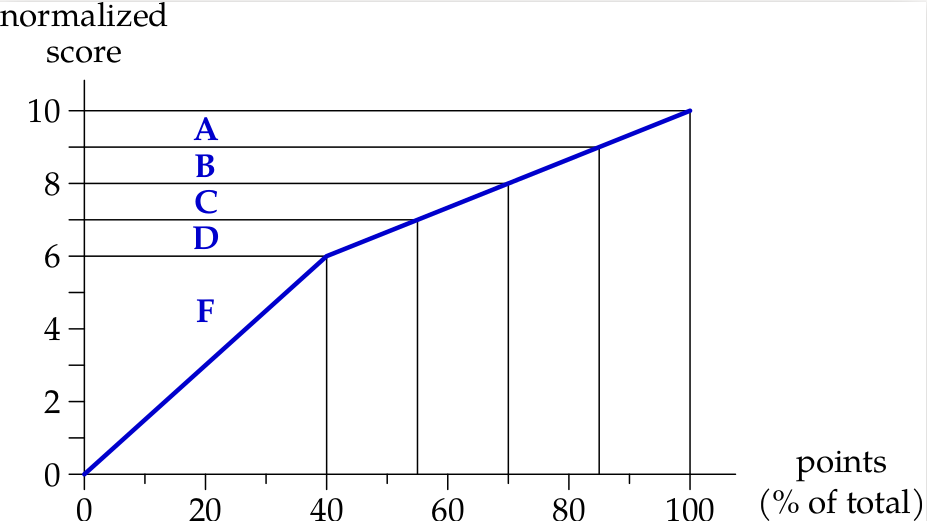
Normalized scores for labs will be computed using the procedure described above for homework problems, with 1/3 of the weekly lab points counted as an A for each week that you received a check-in.
5.1) Lateness
Scores for late submissions of problems or labs will be multiplied by 0.5 if late by less than four days. After four days, scores are reduced to 0.
6) Collaboration Policies
We encourage students to discuss 6.300 concepts and approaches with other students and with the teaching staff. However, students should not take credit for work done by others (including current or previous students). Copying work or knowingly making results available for copying are serious offenses that may result in reduced grades, failing the course, and disciplinary action.
7) Use of Generative AI
Students may use AI to help them understand 6.300 concepts and approaches. However, students should NOT take credit for results generated by AI. Homework solutions that are generated by AI will be graded as though they were copied from other students (and therefore may be in violation of our collaboration policy).
Rationale: The goal of this subject is to introduce students to signal processing techniques and to develop proficiency in their application to understand and solve problems in engineering and science. Learning new techniques and developing thoughtful analyses require productive struggle, and by removing the struggle, AI seriously reduces learning.
Please be aware that our in-class quizzes and final exam are pencil-and-paper exams, and electronic devices may not be used. Therefore you will not have any access to AI resources at the quizzes or final exam.
8) Academic Integrity
Weekly homework assignments provide an opportunity to develop intuition for new concepts by actively applying the new concepts to solve problems and answer questions. The process of actively struggling with the use of new ideas until you understand them is an effective and rewarding form of education. Reading a solution to a problem is not educationally equivalent to generating your own solution. If you skip the process of personally struggling with new concepts by getting the answers from someone else, you will have lost a valuable learning experience.
Good problems are a valuable resource. Don't squander that resource.
For more information, see the academic integrity handbook.
9) Staff
- You may reach all of the course instructors by e-mailing
6.300-instructors@mit.edu.